

Unique at any one time
One account holds a username at a time. Two accounts can share a display name, never a username.
Find the right public Instagram account from a name or a handle, with no login: the rules every username follows, how to tell the account you want from a look-alike, and what a verified badge does and does not confirm.


Can you search Instagram by username without an account?
Yes, for any username you knowEvery Instagram account has one unique username, and its profile lives at that name. A viewer opens the profile from the username with no login. The header shows on every account; the rest opens when the account is public. A changed username can look like one follower leaving and another arriving in a who unfollowed me check.
A username is unique: one account holds it at a time.
The display name is separate, can repeat across accounts and can hold spaces.
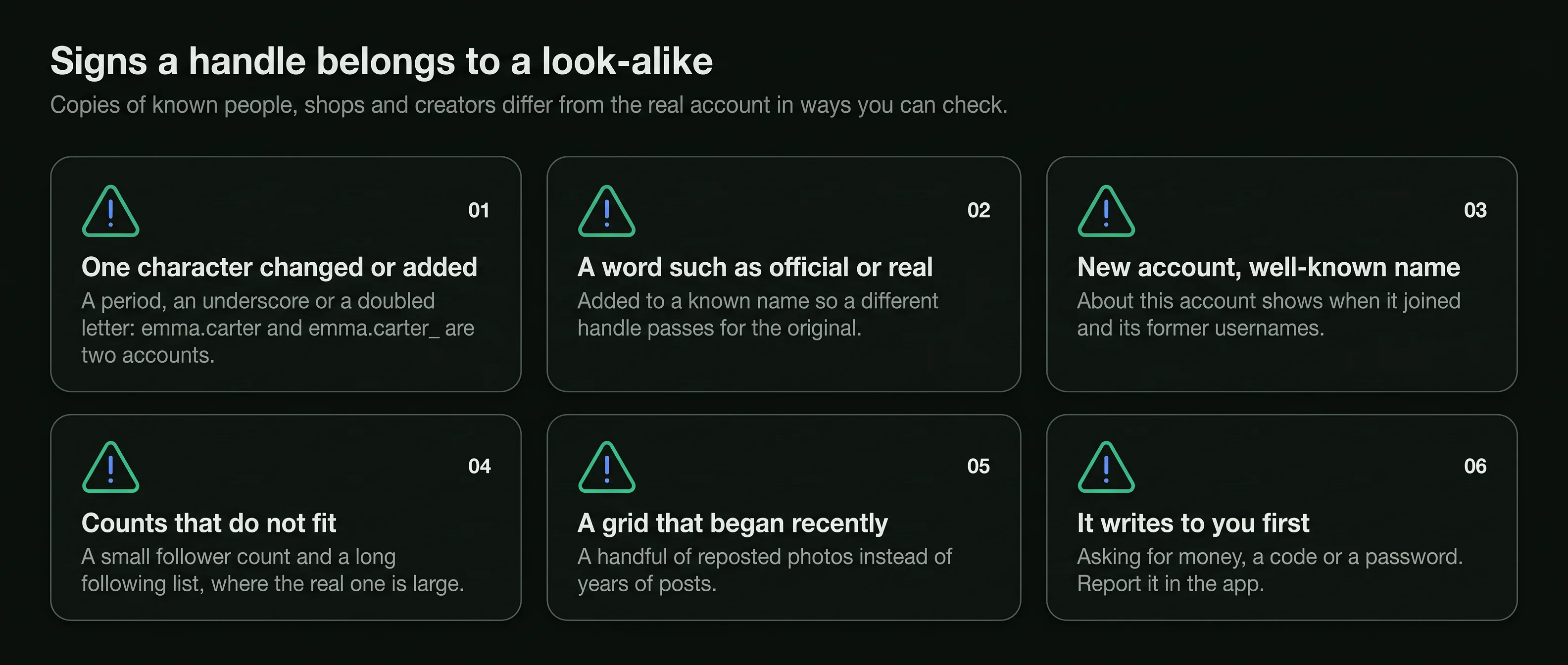
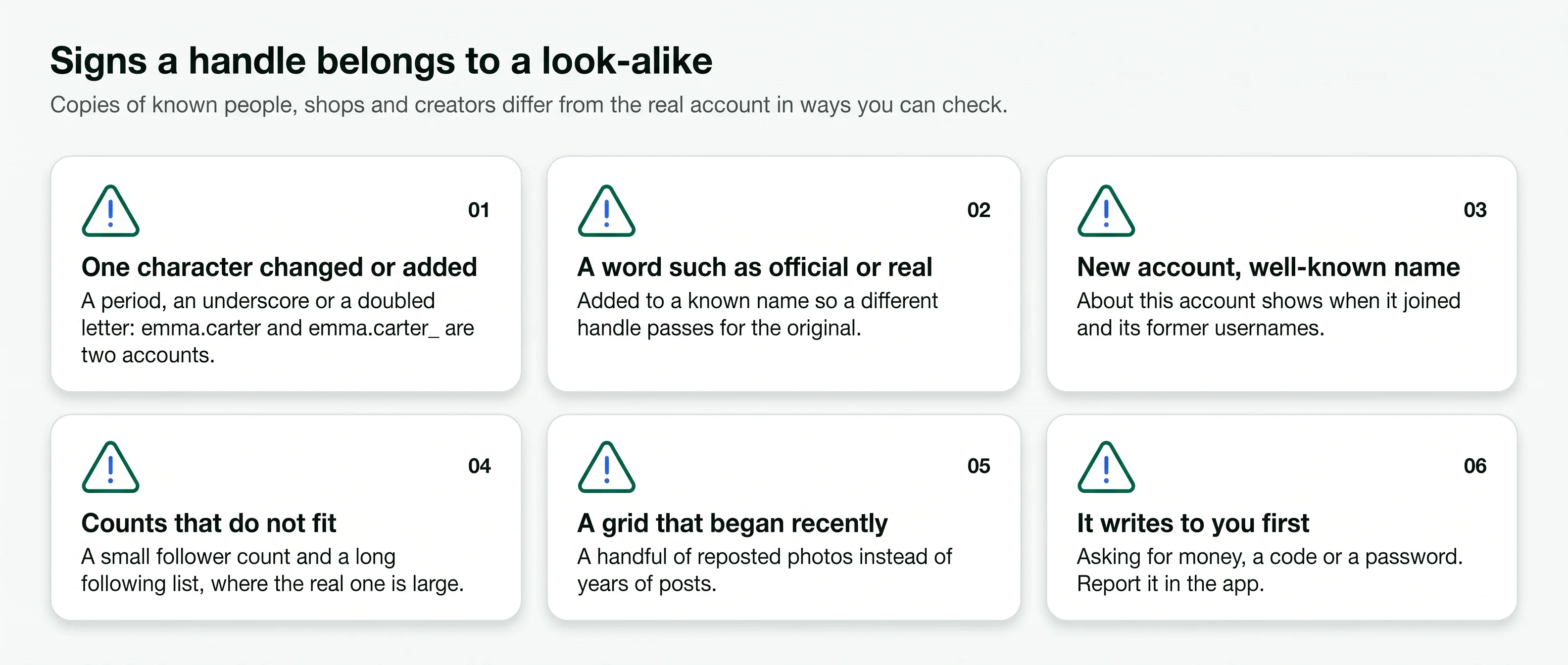
Look-alike accounts copy a handle with one character changed or added.
Searching for someone is not recorded for them, signed in or not.
An Instagram username is the handle after the @ sign. It is unique, so a search for an exact username leads to one account and no other. The profile at that name shows its header to everyone: picture, name, bio and counts. With the handle confirmed, the whole public profile opens in an Instagram profile viewer.
When the account is public, the same search opens its posts, stories and highlights as well. When it is private, the header is all anyone outside the approved followers sees.
The same on a phone or a computer, with no Instagram login.
Enter the handle exactly, without the @ sign. Capitals make no difference; spelling and every period or underscore do.
Compare the name, picture and counts with what you expect. A handle with one character more or less is a different account.
The public profile opens in the browser with its grid, highlights and the stories that are live.
Knowing them helps when a search finds nothing: the handle you typed may break one of them, or differ from the real one by a single character. Once you have the handle, the page on how to view Instagram without an account covers each route to the profile.
One account holds a username at a time. Two accounts can share a display name, never a username.
A username can be at most 30 characters long. Anything longer is not a username, so a long phrase is more likely a display name.
Letters, numbers, periods and underscores. No spaces, no hyphens and no other symbols, which is why handles join words with a period or an underscore.
Usernames are not case-sensitive. EMMA.CARTER and emma.carter are the same handle, and Instagram shows it in lower case.
An owner can change the username. The account keeps its posts and followers, and the old name stops leading to it.
The longest a username can be
Of character: letters, numbers, periods, underscores
Holds a username at any one time
Most failed searches mix the two up. The username is the address; the display name is the label on the door.
Copies of well-known people, shops and creators exist, often to sell something or to ask for money. Five checks sort most of them out.
A copy often adds a period, an underscore or a doubled letter, or a word such as official or real. emma.carter and emma.carter_ are two accounts.
Scroll to the bottom of the grid. An account that began recently with a handful of reposted photos is not the one that has posted for years.
If you know the account has a large following, a copy with a small count and a large following list is not it.
The surest route is the Instagram link on the person's or business's own website, email or card. It carries the real username.
Under a real account's posts, regular people talk to the owner and the owner replies. A copy's comments are often empty or all alike.
In the app, Instagram shows an About this account page for many accounts, with the date the account joined and its former usernames. A recent start under a famous name is a warning sign. Its follower and following lists, opened in an Instagram follower viewer, show who the account is connected to.
An account that writes to you first, under a known name, asking for money, a code or a password, is not the person it names. Report it in the app.
A blue badge beside a username means Instagram has confirmed that the account belongs to the person or business it names. Badges come from two routes: Instagram's own review of notable accounts, and the paid Meta Verified subscription, which checks a government ID.
So a badge settles which account is the real one. It does not say that the account is famous, and it says nothing about whether its posts are accurate. Most real accounts have no badge at all, so the absence of one is not a warning on its own.
The search always finds the account. The privacy setting decides how far in you can go.
Finding a private account by its username shows its header and nothing more. A site that offers its posts or stories is not telling the truth.


A username search needs the handle you are looking for and nothing else. A page that asks for your Instagram login is after your account.
A site that offers to find any account from a phone number or email address has no such list to read. Leave it.
Before you buy from, pay or message an account, follow the link from its own website or another channel you already trust.
The handle may be misspelled, changed or deleted. Check periods and underscores, then search the display name instead.
The same display name, yes. The same username, never: one account holds a handle at a time.
No. A deactivated account is hidden until its owner returns, and its username leads nowhere meanwhile.
Short answers to what people ask when they look for an Instagram account by name or handle.
Type a public username and open the viewer. No Instagram login on your side, no name on theirs.


